


xiouping
modalities: the body keeps time
March 28 to May 9

Reception for the artist is on Saturday April 11, 3-5 pm at Beyond Baroque, 681 N. Venice Blvd, Venice CA 90291.
The work of artist xiouping is a 12-minute video and sound installation composed of a looped single-channel video. The camera stays in a fixed position inside a bedroom. We see a woman pushing someone in a wheelchair off camera, and then the same woman coming and going, tidying the room and the bed, carrying cups and bottles away from the bedside table, arranging medications, emptying the commode and changing the lining, placing new mattress protectors on the bed, and performing many actions indicative of caregiving to a disabled person, who is off camera. Also off-camera there are sounds of language fragments in English and Taiwanese, and English subtitles. The work is organized by the tension between the seen and the unseen, produced through strict formal constraints: cleaning, feeding, and tending. The patient is unseen, while the caregiver’s body and labor are centered. Care persists without exit, and rest is structurally withheld.
The actions happen for someone, by someone else. The actions are repeated, interrupted, paused, taking a certain amount of time in real time, constituting the conditions and the duration of care, hence the artwork. Emotions are neither shown nor implied. The receiver of care is not visible, perhaps for privacy and dignity, or perhaps because the video is primarily a portrait of the caregiver. In medical terminology, modalities are specific methods, tools, or techniques used to achieve a particular result, commonly applied in healthcare to treat conditions, or in physical therapy to relieve pain. But here modalities are also the formal devices that structure the video but also the conditions of its reception by the viewer who sees what is in front of their eyes, by they are also given the time to free-associate, imagine, empathize, assume or presume: is the caregiver the same person as the artist? Are we not witnessing the invisible labor of women and immigrants? Is the caregiver a professional or a family member?
In many ways, this one long take video is informed by the tradition of films of “ordinary experience” as Frederick Wiseman called them, the intentionally boring observations of everyday rituals and situations, or the immersive, static shots of Chantal Ackerman. What xiouping’s video shares with Wiseman and Ackerman is also its unrelenting materialism, refusing metaphor or explanatory voice-overs and focusing as it does on everyday actions in real time. The body indeed keeps time, both for the receiver and for the giver of care.
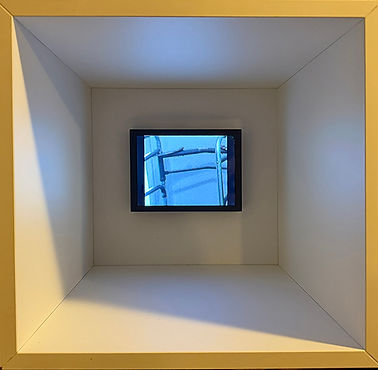
The “walls” of the proxy Gallery mirror the walls of a room and underscore the idea of a boundary. Special material conditions of viewing arranged by the artist take accessibility into account: The gallery is placed at a lower height to be visible from a seat or a wheelchair. In this way the installation does not assume a default upright, able-bodied viewing position. Instead, it allows for multiple physical orientations to the work — standing briefly, leaning, or sitting. Care reorganizes how bodies relate to space, and the viewing condition reflects that variability rather than prescribing a single normative stance.